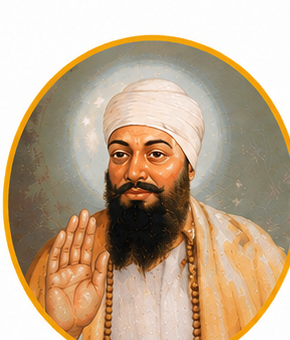
Fifth Sikh Guru · 1563–1606
Arjan Dev Ji
ਗੁਰੂ ਅਰਜਨ ਦੇਵ ਜੀ
Guru Arjan Dev Ji, the fifth Sikh Guru, compiled the Adi Granth — the first edition of the Sikh holy scripture — and installed it in Harmandir Sahib in 1604. He became the first Sikh martyr in 1606, sacrificing his life rather than converting to Islam under the Mughal Emperor Jahangir.
Life Story
Guru Arjan Dev Ji was born on 15 April 1563 in Goindval Sahib, the youngest son of Guru Ram Das Ji. He was appointed the fifth Sikh Guru in 1581 at just 18 years of age. Under his leadership, Sikhism grew rapidly across Punjab and beyond. He completed the construction of Harmandir Sahib — the Golden Temple — in Amritsar, designing it with four doors open to all four directions, symbolising that all people from all directions and all walks of life are equally welcome.
Guru Arjan Dev Ji's most monumental achievement was the compilation of the Adi Granth in 1604 — the first authentic edition of the Sikh holy scripture. He gathered the Shabads of the first four Gurus, added his own vast compositions, and — crucially — included the writings of saints from other traditions: Hindu Bhagats like Kabir, Namdev, and Ravidas, and Muslim Sufis like Baba Farid. This universal scripture, containing hymns in multiple languages, embodied the Sikh principle that truth transcends all religious boundaries.
His Guruship also saw major growth in the organisational and economic capacity of the Sikh community. He oversaw Sikh settlements across Punjab and beyond, managed a substantial treasury from offerings, and advocated for the rights of the community in dealings with the Mughal court. His rapid popularity, however, attracted the jealousy of rivals. His own brother Prithi Chand had contested the Guruship, and enemies brought false accusations before Emperor Jahangir.
In 1606, Mughal Emperor Jahangir ordered Guru Arjan Dev Ji's arrest, accusing him of blessing a rebel prince. He was subjected to severe torture for several days in Lahore — made to sit on a red-hot iron plate, had boiling water poured over him, and was forced to sit on hot sand — yet he bore every pain with complete serenity. He was then taken to the Ravi river, where he immersed himself and was seen no more. His martyrdom is commemorated on Shahidi Divas and transformed the course of Sikh history, marking the faith's transition from a purely peaceful movement to one that would also take up the sword in self-defence.
Key Contributions
Compiled the Adi Granth (1604)
Compiled the first edition of the Sikh holy scripture, including writings from saints of multiple faiths — a groundbreaking act of religious universalism.
Completed Harmandir Sahib
Finished building the Golden Temple with four doors open to all four directions, symbolising welcome to people of every faith and caste.
First Sikh Martyr
Endured torture and gave his life in 1606 rather than renounce his faith or alter the Adi Granth — setting a precedent of supreme sacrifice.
Composed 2,218 Shabads
The largest collection in Sri Guru Granth Sahib Ji, spanning all 31 ragas in the scripture, including the Sukhmani Sahib.
Established Tarn Taran & Kartarpur
Founded new Sikh settlements across Punjab, including a leper colony, and expanded the Masand system across the subcontinent.
Core Philosophy
Guru Arjan Dev Ji, the fifth Sikh Guru, compiled the Adi Granth — the first edition of the Sikh holy scripture — and installed it in Harmandir Sahib in 1604. He became the first Sikh martyr in 1606, sacrificing his life rather than converting to Islam under the Mughal Emperor Jahangir.
”Timeline
Prakash (Birth)
Goindval Sahib, Amritsar district, Punjab
Joti Jot
Sacred Places
Place of Birth
Goindval Sahib, Amritsar district, Punjab
The sacred birthplace of the Guru
Arjan Dev Ji's Life
Watch the story of Arjan Dev Ji's life and legacy.