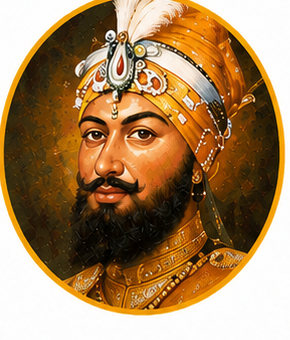
Tenth Sikh Guru · 1666–1708
Gobind Singh Ji
ਗੁਰੂ ਗੋਬਿੰਦ ਸਿੰਘ ਜੀ
Guru Gobind Singh Ji, the tenth and final human Sikh Guru, founded the Khalsa Panth on Vaisakhi 1699, bestowing Sikhs with the Five Ks (Panj Kakars) and the names Singh and Kaur. He declared Sri Guru Granth Sahib Ji as the eternal, living Guru — the final and everlasting Guru of the Sikhs.
Life Story
Guru Gobind Singh Ji was born on 22 December 1666 in Patna Sahib, Bihar, and became the tenth Sikh Guru in 1675 at the age of nine — the same age at which his father, Guru Tegh Bahadur Ji, was martyred. He grew up in Anandpur Sahib, receiving a thorough education in Sanskrit, Persian, Arabic, Punjabi, Braj Bhasha, and martial arts. His childhood was scarred by the loss of his father and the great sacrifices of the early Sikh community — experiences that would forge a Guru of extraordinary courage, creativity, and vision.
On Vaisakhi 1699, Guru Gobind Singh Ji called the entire Sikh nation to gather at Anandpur Sahib for a historic transformation. Standing before a vast congregation, he drew his sword and called for a Sikh willing to give his head. One by one, five Sikhs — the Panj Pyare (Five Beloved Ones) — stepped forward to offer their lives. These five were then initiated into the Khalsa Panth: Guru Gobind Singh Ji prepared Amrit (nectar of immortality) in an iron bowl, stirring it with a double-edged sword while Gurbani was recited, and the five drank from the same bowl — abolishing caste distinctions in one powerful act. He then asked the Panj Pyare to initiate him in return, making himself both the creator and a member of the Khalsa.
He gave the Khalsa the Panj Kakars — five articles of faith (Kesh, Kara, Kanga, Kachera, Kirpan) — and the names Singh (lion) for men and Kaur (princess) for women. He commanded that the Khalsa was to be the Guru's army of the spiritually sovereign and the defenders of the weak. He also fought numerous battles against the Mughal forces and Hill Rajas — including the Battle of Chamkaur (1704), where his two elder sons, Ajit Singh and Jujhar Singh, fought and were martyred.
At the Battle of Chamkaur, Guru Gobind Singh Ji's two younger sons — Sahibzada Zorawar Singh (age 9) and Fateh Singh (age 7) — were captured with their grandmother Mata Gujri. When they refused to convert to Islam before the Nawab of Sirhind, they were bricked alive into a wall and martyred. All four sons of the Guru gave their lives for the faith, earning them the title of the Char Sahibzade (Four Sons). Despite these immense personal losses, Guru Gobind Singh Ji continued his mission without despair, writing the Zafarnama — a letter of moral victory — to Emperor Aurangzeb.
Guru Gobind Singh Ji completed the final edition of Sri Guru Granth Sahib Ji, adding the compositions of Guru Tegh Bahadur Ji. Before his passing in 1708 at Nanded, Maharashtra (where Gurudwara Hazur Sahib now stands), he declared that there would be no more human Gurus. Henceforth, Sri Guru Granth Sahib Ji would be the eternal, living, and everlasting Guru of the Sikhs. This declaration gave Sikhism its unique scripture-as-Guru theology. He was a warrior, poet, philosopher, and saint — a figure of supreme courage who sacrificed everything for his people and for justice.
Key Contributions
Founded the Khalsa Panth (Vaisakhi 1699)
Created the order of the Khalsa — the community of initiated Sikhs — abolishing caste and giving Sikhs a shared, sovereign identity.
Bestowed the Panj Kakars
Gave Sikhs the five articles of faith (Kesh, Kara, Kanga, Kachera, Kirpan) that distinguish the Khalsa and carry deep spiritual significance.
Declared Guru Granth Sahib Ji as Eternal Guru
In 1708, proclaimed the scripture as the living, eternal Guru — the most consequential theological decision in Sikh history.
Sacrificed All Four Sons
All four Sahibzade were martyred in battle and by execution — the Guru bore these losses with extraordinary faith and composure.
Poet, Scholar & Warrior
Composed the Nitnem Banis, the Jaap Sahib, Chaupai Sahib, and vast poetic works in Braj Bhasha and Persian — one of the greatest poets of the Mughal era.
Core Philosophy
Guru Gobind Singh Ji, the tenth and final human Sikh Guru, founded the Khalsa Panth on Vaisakhi 1699, bestowing Sikhs with the Five Ks (Panj Kakars) and the names Singh and Kaur. He declared Sri Guru Granth Sahib Ji as the eternal, living Guru — the final and everlasting Guru of the Sikhs.
”Timeline
Prakash (Birth)
Patna Sahib, Bihar
Joti Jot
Sacred Places
Place of Birth
Patna Sahib, Bihar
The sacred birthplace of the Guru
Gobind Singh Ji's Life
Watch the story of Gobind Singh Ji's life and legacy.