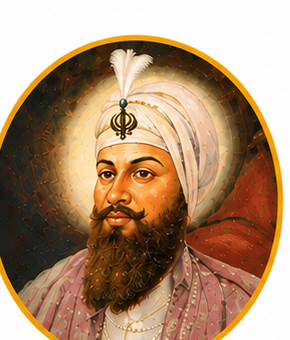
Seventh Sikh Guru · 1630–1661
Har Rai Sahib Ji
ਗੁਰੂ ਹਰਿ ਰਾਇ ਸਾਹਿਬ ਜੀ
Guru Har Rai Sahib Ji, the seventh Sikh Guru, was known for his compassionate spirit and love of nature. He maintained a large army but never engaged in offensive warfare, preferring peace. He established a free hospital and distributed medicines to the sick, embodying the Sikh value of sewa (selfless service).
Life Story
Guru Har Rai Sahib Ji was born on 16 January 1630 in Kiratpur Sahib, the grandson of Guru Hargobind Sahib Ji. He became the seventh Sikh Guru in 1644 at the age of fourteen. He was known for his gentle, compassionate nature — deeply devoted to the well-being of all living creatures. A beloved story tells of how as a young boy he accidentally brushed a flower from a plant while passing — and was so distressed that he thereafter always held his robe close to avoid harming any plant or creature. This sensitivity characterised his entire Guruship.
Despite maintaining an army of 2,200 trained soldiers — honouring the military tradition established by his grandfather — Guru Har Rai never initiated conflict or offensive warfare. He saw the army as a force for protection, not aggression. He was a man of peace who believed the sword should be a last resort. He spent much of his time in the Himalayan foothills of Punjab — in Kiratpur, Sirmur, and beyond — holding darbars, connecting with the sangat, and peacefully spreading Gurbani.
Guru Har Rai Ji established a free ayurvedic hospital and herbal garden at Kiratpur Sahib, where medicines were prepared and distributed to the sick at no cost — a remarkable public health initiative for the 17th century. His compassion extended to the animal kingdom: he maintained a large zoo and sanctuary where wounded, sick, and rare animals were cared for. A famous incident recalls how, when Mughal Prince Dara Shikoh fell gravely ill, his father Emperor Shah Jahan sent a request for medicine. Despite the enmity between the Mughals and the Sikh Gurus, Guru Har Rai sent a rare Sikh herbal remedy that saved Dara Shikoh's life — an act of pure compassion that transcended political conflict.
Towards the end of his life, the new Mughal Emperor Aurangzeb summoned Guru Har Rai Ji to Delhi on accusations of supporting the rebel prince Dara Shikoh. Rather than present himself before a hostile court, Guru Har Rai sent his elder son Ram Rai as his representative. However, Ram Rai altered a verse of Gurbani to appease Aurangzeb, an act of compromise that the Guru could not forgive. He disinherited Ram Rai and before his passing in 1661, appointed his younger son — the five-year-old Har Krishan — as the eighth Guru.
Key Contributions
Free Herbal Hospital
Established a free ayurvedic hospital and medicinal herb garden at Kiratpur Sahib, providing healthcare to all regardless of means.
Saved Prince Dara Shikoh
Sent rare herbal medicine to cure the Mughal prince — a profound act of compassion toward a political enemy, demonstrating Sikh values.
Wildlife Sanctuary
Maintained a sanctuary where wounded and rare animals were cared for, reflecting his deep reverence for all living beings.
Preserved the Adi Granth's Integrity
Disinherited his son for altering a verse of Gurbani to please the Mughal Emperor, upholding the sanctity of Sikh scripture.
Maintained the Sant Sipahi Tradition
Kept a 2,200-strong army for defence while pursuing peace — a model of strength with restraint.
Core Philosophy
Guru Har Rai Sahib Ji, the seventh Sikh Guru, was known for his compassionate spirit and love of nature. He maintained a large army but never engaged in offensive warfare, preferring peace. He established a free hospital and distributed medicines to the sick, embodying the Sikh value of sewa (selfless service).
”Timeline
Prakash (Birth)
Kiratpur Sahib, Rupnagar district, Punjab
Joti Jot
Sacred Places
Place of Birth
Kiratpur Sahib, Rupnagar district, Punjab
The sacred birthplace of the Guru
Har Rai Sahib Ji's Life
Watch the story of Har Rai Sahib Ji's life and legacy.