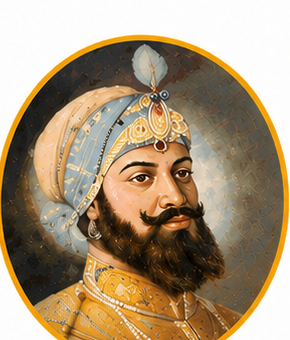
Sixth Sikh Guru · 1595–1644
Hargobind Sahib Ji
ਗੁਰੂ ਹਰਗੋਬਿੰਦ ਸਾਹਿਬ ਜੀ
Guru Hargobind Sahib Ji, the sixth Sikh Guru, transformed the community by introducing the concept of Miri-Piri — the twin kirpans representing temporal and spiritual authority. He built the Akal Takht opposite Harmandir Sahib and organised the Sikhs into a military force to defend against Mughal oppression.
Life Story
Guru Hargobind Sahib Ji was born on 19 June 1595 in Vadali village near Amritsar. He became the sixth Sikh Guru at just eleven years old, following the martyrdom of his father Guru Arjan Dev Ji. The transformation he brought to Sikhism was profound and deliberate: responding to his father's martyrdom, he declared that Sikhs would henceforth be warriors as well as saints. At his anointing, he wore two kirpans — one representing Miri (temporal sovereignty) and the other Piri (spiritual authority). This concept of Miri-Piri remains a cornerstone of Sikh identity.
In 1606 he constructed the Akal Takht ('Throne of the Timeless God') directly across from Harmandir Sahib in Amritsar. While Harmandir Sahib represented spiritual guidance, the Akal Takht became the seat of Sikh temporal authority — the place where worldly and political matters affecting the Panth were deliberated. It remains the highest seat of Sikh political and spiritual authority today. He also kept a stable of 800 horses, maintained a retinue of 300 armed followers, and encouraged Sikhs to learn and practice martial arts.
Emperor Jahangir initially imprisoned Guru Hargobind Sahib Ji in the Gwalior Fort, alongside 52 Hindu princes who had also been jailed. When Emperor Jahangir ordered his release, Guru Hargobind refused to leave without the other prisoners. The Emperor agreed to release as many princes as could hold on to Guru Hargobind's cloak simultaneously — so the Guru had a cloak stitched with 52 strings, one for each prince, and led them all to freedom. He is thus remembered as Bandi Chhor Divas (Liberator of Captives), and his return to Amritsar coincided with Diwali — a celebration that Sikhs commemorate to this day.
Guru Hargobind Sahib Ji fought four battles against the Mughal forces of Shah Jahan — at Amritsar, Kartarpur, Gurusar, and Nangal — winning all four. He spent his final years in Kiratpur Sahib in the Himalayan foothills, away from Mughal reach, where he passed from this world in 1644. He is remembered as the Warrior Guru (Sant Sipahi) and the architect of a Sikhism that balanced deep spirituality with the courage to defend the weak.
Key Contributions
Introduced Miri-Piri
Wore two kirpans representing temporal and spiritual authority, transforming Sikhs from a purely devotional community into a saint-soldier (Sant Sipahi) tradition.
Built Akal Takht
Constructed the seat of Sikh temporal authority in Amritsar in 1606 — still the highest decision-making body of the Sikh Panth.
Bandi Chhor — Released 52 Prisoners
Secured the release of 52 Hindu princes from Gwalior Fort by refusing to leave without them, earning the title 'Liberator of Captives'.
Won Four Battles Against Mughals
Led successful military campaigns against Mughal forces at Amritsar, Kartarpur, Gurusar, and Nangal, defending Sikh sovereignty.
Established the Sant Sipahi Ideal
Defined the Sikh warrior-saint ideal: equally devoted to scripture and the sword, spiritual practice and the defence of the innocent.
Core Philosophy
Guru Hargobind Sahib Ji, the sixth Sikh Guru, transformed the community by introducing the concept of Miri-Piri — the twin kirpans representing temporal and spiritual authority. He built the Akal Takht opposite Harmandir Sahib and organised the Sikhs into a military force to defend against Mughal oppression.
”Timeline
Prakash (Birth)
Vadali, Amritsar district, Punjab
Joti Jot
Sacred Places
Place of Birth
Vadali, Amritsar district, Punjab
The sacred birthplace of the Guru
Hargobind Sahib Ji's Life
Watch the story of Hargobind Sahib Ji's life and legacy.