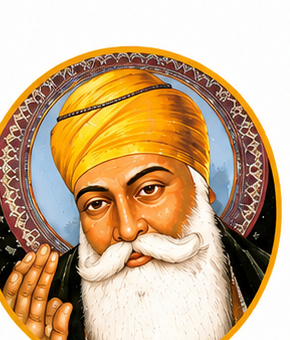
First Sikh Guru · 1469–1539
Nanak Dev Ji
ਗੁਰੂ ਨਾਨਕ ਦੇਵ ਜੀ
The founder of Sikhism and the first of the Ten Gurus, Guru Nanak Dev Ji was born in 1469 in Nankana Sahib (present-day Pakistan). He spread the message of Ik Onkar — one universal Creator — and taught that all humans are equal before God. His hymns form the foundation of Sri Guru Granth Sahib Ji.
Life Story
Guru Nanak Dev Ji was born on 15 April 1469 (celebrated on Kartik Pooranmashi) in Rai Bhoi di Talwandi, now known as Nankana Sahib in present-day Pakistan. From an early age he showed deep spiritual awareness, often meditating instead of working and questioning the rituals of the day. His father, Mehta Kalu, tried to engage him in trade and farming, but the young Nanak gave away goods to feed the hungry — an early expression of the sewa (selfless service) that would define Sikhism.
At around age 30, Guru Nanak had a profound spiritual experience at the Bein river near Sultanpur Lodhi. He disappeared underwater for three days, and when he emerged he declared: 'There is no Hindu, there is no Muslim' — proclaiming the oneness of humanity under one God. This moment marks the founding of the Sikh faith. He then began his four great journeys, known as the Udasis, travelling thousands of miles across South Asia, the Middle East, and Central Asia — as far as Mecca and Baghdad — spreading his message of Ik Onkar (One Creator).
Guru Nanak challenged the hypocrisy of religious orthodoxy, the injustice of the caste system, and the oppression of women. He taught through his Shabads (hymns), composed in multiple languages and poetic forms, which were later compiled into Sri Guru Granth Sahib Ji. His three core teachings — Naam Japna (meditating on God's name), Kirat Karni (earning an honest living), and Vand Chakna (sharing with others) — remain the pillars of Sikh daily life.
Before leaving this world in 1539 at Kartarpur, Guru Nanak founded the city of Kartarpur (in present-day Pakistan) as a model community where people of all castes and religions lived, worked, and ate together. He established the Langar (community kitchen) as a cornerstone institution and appointed his devoted disciple Bhai Lehna as his successor — giving him the name Angad, meaning 'my own limb'. Guru Nanak Dev Ji passed from this world in the early hours of a September morning, leaving behind a faith that would eventually count hundreds of millions of followers worldwide.
Key Contributions
Founded Sikhism
Established a new faith centred on one God, equality of all humans, and selfless service — rejecting caste, ritual, and idol worship.
Four Udasis (Great Journeys)
Travelled over 28,000 km across South Asia, the Middle East, Tibet, and Central Asia, engaging scholars, saints, and rulers in discourse.
Composed 974 Shabads
His hymns form the largest single contribution to Sri Guru Granth Sahib Ji, covering every raga (musical mode) and poetic form.
Founded Kartarpur
Established the first Sikh community town, where Langar was served freely to all regardless of caste, religion, or status.
Introduced Naam Simran
Taught that meditating on God's name (Waheguru) is the highest spiritual practice, accessible to every person regardless of background.
Core Philosophy
The founder of Sikhism and the first of the Ten Gurus, Guru Nanak Dev Ji was born in 1469 in Nankana Sahib (present-day Pakistan). He spread the message of Ik Onkar — one universal Creator — and taught that all humans are equal before God. His hymns form the foundation of Sri Guru Granth Sahib Ji.
”Timeline
Prakash (Birth)
Nankana Sahib, Punjab (present-day Pakistan)
Joti Jot
Sacred Places
Place of Birth
Nankana Sahib, Punjab (present-day Pakistan)
The sacred birthplace of the Guru
Nanak Dev Ji's Life
Watch the story of Nanak Dev Ji's life and legacy.