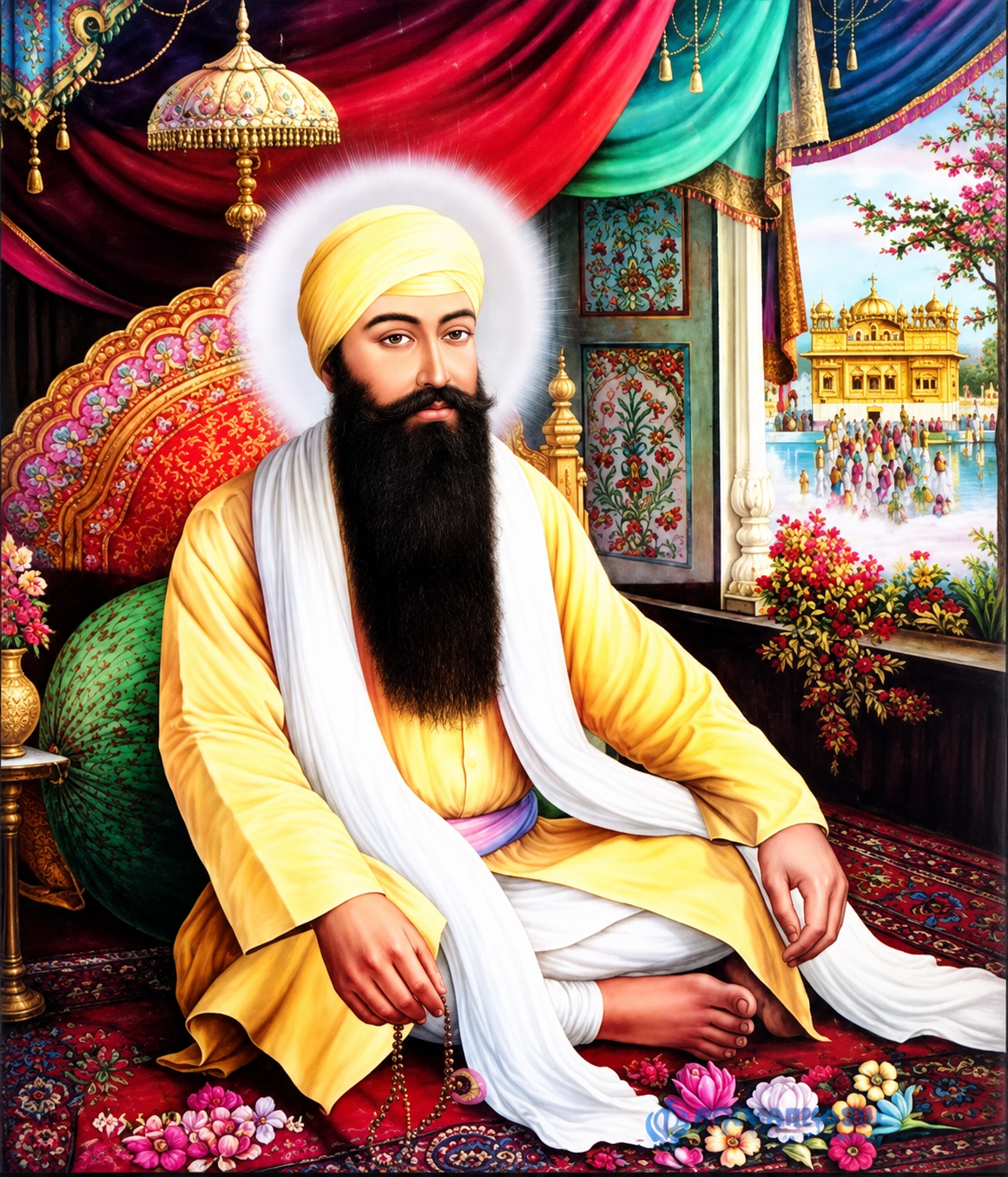
Fourth Sikh Guru · 1534–1581
Ram Das Ji
ਗੁਰੂ ਰਾਮ ਦਾਸ ਜੀ
Guru Ram Das Ji, the fourth Sikh Guru, founded the holy city of Amritsar and began construction of the sacred sarovar (pool) which would later become the site of Harmandir Sahib (Golden Temple). He composed the Lavaan, the Sikh wedding hymn still recited at every Anand Karaj ceremony today.
Life Story
Guru Ram Das Ji was born Bhai Jetha on 24 September 1534 in Lahore (present-day Pakistan). Orphaned at a young age, he moved to Goindval Sahib where he came under the guidance of Guru Amar Das Ji. His extraordinary devotion and selfless service earned him the deep admiration of the Guru, and in 1574 he was appointed the fourth Sikh Guru. His appointment also established the hereditary principle — from this point on, the Guruship remained within the family of Guru Nanak, with Guru Ram Das Ji being the son-in-law of Guru Amar Das Ji.
Guru Ram Das Ji's most enduring contribution was the founding of the city of Amritsar, originally called Guru Ka Chakk or Ramdaspur. In 1577 he acquired the land from Emperor Akbar (at a nominal price) and began excavating the sacred pool — the Amrit Sarovar (Pool of Nectar) — which gave the city its name. This sarovar would later become the site of Harmandir Sahib, the Golden Temple, built by his son Guru Arjan Dev Ji.
He invited traders, artisans, and merchants of 52 different trades to settle in Amritsar, rapidly developing it into a major commercial and spiritual hub. This combination of the sacred and the practical — a holy city that was also a thriving marketplace — reflected a core Sikh value: that spiritual and worldly life are inseparable. He also deepened the Manji system by creating the Masand system, a network of representatives who could collect offerings and spread the Guru's message across greater distances.
Guru Ram Das Ji composed the Lavaan — four sacred verses that form the core of the Anand Karaj (Sikh wedding ceremony). The Lavaan describe the soul's journey toward union with God, using the metaphor of a bride and groom. These hymns are recited and circumambulated around Sri Guru Granth Sahib Ji at every Sikh wedding to this day. He composed 679 Shabads in total and was succeeded by his youngest son, Guru Arjan Dev Ji.
Key Contributions
Founded Amritsar
Established the holy city of Amritsar (Ramdaspur) in 1577, purchasing the land and beginning the excavation of the sacred sarovar.
Composed the Lavaan
Wrote the four-verse wedding hymn recited at every Anand Karaj (Sikh wedding ceremony) to this day.
Established the Masand System
Created a network of appointed representatives to spread the Guru's message and collect offerings across a wider geography.
Developed the Sikh Economy
Invited 52 trades to settle in Amritsar, integrating commerce with spirituality and building a prosperous Sikh community.
Composed 679 Shabads
His hymns in Sri Guru Granth Sahib Ji span numerous ragas and explore themes of devotion, God's grace, and the nature of service.
Core Philosophy
Guru Ram Das Ji, the fourth Sikh Guru, founded the holy city of Amritsar and began construction of the sacred sarovar (pool) which would later become the site of Harmandir Sahib (Golden Temple). He composed the Lavaan, the Sikh wedding hymn still recited at every Anand Karaj ceremony today.
”Timeline
Prakash (Birth)
Lahore, Punjab (present-day Pakistan)
Joti Jot
Sacred Places
Place of Birth
Lahore, Punjab (present-day Pakistan)
The sacred birthplace of the Guru
Ram Das Ji's Life
Watch the story of Ram Das Ji's life and legacy.